

Meta’s enterprise AI strategy is moving beyond consumer-facing assistants. On September 28, 2026, Meta announced the Meta Enterprise Platform, naming Muse, Meta Business Agent, Muse API, and Muse Code among its initial products for businesses and developers. The announcement confirms the platform’s enterprise direction, but it does not yet publish detailed Muse API capabilities, pricing, rate limits, security controls, integrations, or general-availability terms.
That distinction matters. The Meta Muse API launch creates a potentially important development path for companies, but businesses should treat many proposed workflows as implementation opportunities rather than confirmed product features. Teams evaluating the platform will need to wait for technical documentation before committing to production architecture, compliance assumptions, or customer-facing promises.
What the Meta Muse API could change for business workflows
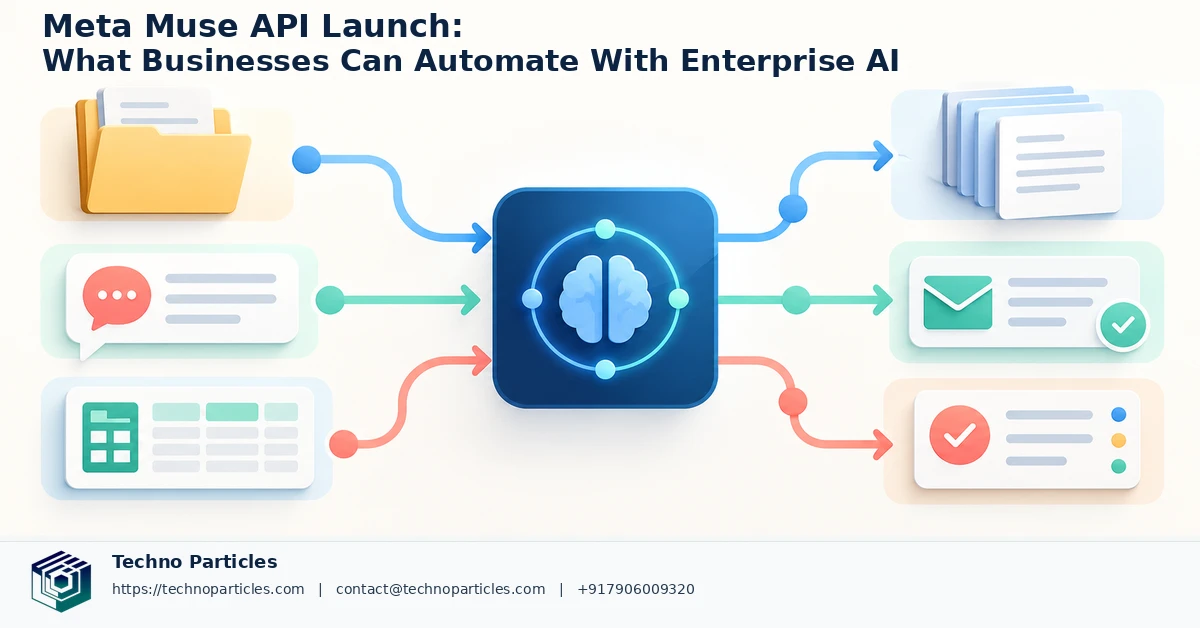
If the API exposes reliable enterprise model access and suitable controls, companies could explore automation around customer-service triage, internal knowledge search, document processing, lead qualification, content operations, and software development. For example, a connected workflow might classify incoming enquiries, retrieve approved information, prepare a draft response, and send the case to a human employee for review. That is a practical design pattern, not a confirmed Muse API capability.
Similar systems could help extract structured fields from business documents, summarize operational reports, or surface relevant records from a private knowledge base. A company building such workflows would still need authentication, permissions, audit logs, retention rules, prompt testing, and escalation paths. Human review is especially important when generated output affects customers, employees, payments, contracts, or regulated information.
What Meta has confirmed so far
Meta separately introduced a public preview of the Meta Model API on July 9, 2026, with access to Muse Spark 1.1. Meta’s developer documentation now presents Muse Spark and related tools, but the available research does not establish that every developer tool or model is included in the enterprise Muse API offering. Businesses can monitor the documentation and consult a qualified technology project consultation service before selecting an integration path.
How businesses should evaluate a Muse API workflow
The first step is to define a narrow, measurable process rather than asking an AI model to run an entire department. A support team might begin with enquiry classification and suggested replies, while a sales team could test lead enrichment and routing. Finance or operations teams may start with document extraction, provided sensitive fields are checked before they enter any external service. These pilots create a safer way to measure accuracy, review time, escalation volume, and the cost of human oversight.
Design the human and system controls first
Any proposed Meta Muse API integration would need a clear boundary between generated suggestions and actions that change business records. A model could prepare a draft, but a permissioned application should decide whether to update a CRM, send an email, issue a refund, or alter an employee record. Role-based access, approval queues, logging, data-retention policies, and fallback handling should be designed before automation is connected to live systems.
Testing should also use representative examples, including incomplete requests, conflicting documents, ambiguous customer messages, and attempts to obtain restricted information. Teams should record where the model is uncertain and create escalation rules for those cases. Because Meta has not yet documented the Muse API’s final limits, integrations, or security controls in the supplied announcement, businesses should avoid treating a preview, a product name, or a developer reference as a production commitment.
Where developers can begin without overcommitting
Developers can map existing APIs, data sources, approval steps, and user permissions while monitoring Meta’s official documentation for concrete access terms. A prototype can use anonymized or synthetic data, with model outputs reviewed by staff before any customer-facing action. This preparation also makes it easier to compare Muse with other enterprise AI options on reliability, privacy, hosting, integration effort, and total operating cost. Businesses planning a custom workflow can review application development services to assess the surrounding web application, backend, and integration requirements.
Turn the Meta Muse API launch into a controlled pilot
A sensible pilot should connect one business process to one measurable outcome. For customer support, that might mean sorting incoming messages by topic and urgency before an employee responds. For sales, it could mean identifying missing information in a lead record and recommending the next task. These uses keep the model in an assistive role while the business measures accuracy, turnaround time, exception rates, and review effort.
Teams should document the data that enters the workflow and the systems that receive its output. A document-processing experiment, for example, may need separate rules for public files, internal records, personal information, and commercially sensitive material. Synthetic or anonymized data is preferable during early testing, especially while Meta has not published complete Muse API details for security, retention, regional processing, or access controls.
What businesses should verify before production access
The Meta Muse API launch should be evaluated against questions that apply to any enterprise AI service. Is the intended model available to the company’s region and account type? Are there documented quotas, latency expectations, logging options, and support channels? Can administrators restrict users, inspect activity, and revoke access? Does the service integrate with the CRM, CMS, help desk, data warehouse, or identity provider already used by the business?
These answers determine whether a promising demonstration can become a dependable workflow. They also affect procurement, legal review, and the cost of maintaining fallback systems. A prototype that works in a controlled test may still require queue management, retry handling, output validation, and a manual route when the API is unavailable or produces an uncertain result.
For Indian SMEs and growing teams, the surrounding application can be as important as the model itself. A secure dashboard, permission layer, approval queue, and analytics view can turn an experimental prompt into an accountable operating process. Businesses assessing that wider implementation can explore generative AI development services alongside their own technical and compliance review.
What a Meta Muse API workflow could automate
The Meta Muse API launch is most useful as a planning signal for businesses assessing enterprise AI, not as proof that every proposed workflow is available today. Once Meta publishes detailed capabilities and access terms, teams could evaluate Muse for tasks such as classifying customer enquiries, extracting fields from business documents, searching approved internal knowledge, or preparing responses for employee review. These are potential application patterns, not confirmed Muse API features.
Start with repeatable, reviewable work
A strong candidate for automation usually has clear inputs, a defined decision process, and an outcome that can be checked. A retailer might use an AI-assisted workflow to organise product questions before a support employee replies. A distributor could test whether incoming purchase documents contain required fields. A marketing team might prepare content variations from an approved product brief, while keeping publication and brand review under human control.
Each workflow should specify what the model is allowed to do and what remains outside its authority. Generating a draft, tagging a record, or recommending a next step is materially different from issuing a refund, changing a customer’s account, or sending a legally significant message. The surrounding application should enforce those boundaries with permissions, validation rules, approval steps, and an audit trail.
Build the data path before choosing the model
Businesses should map where information originates, how it is transformed, and which system receives the result. That map may include a website form, CRM, help desk, document store, analytics platform, or employee portal. It should also identify personal data, confidential files, retention requirements, and the point at which a human must intervene.
During evaluation, teams can use synthetic or anonymized records and compare AI-assisted performance with the existing manual process. Useful measures include classification accuracy, correction time, unresolved cases, escalation frequency, and operating cost. Companies preparing this foundation can review CMS and workflow implementation services

Design the workflow around accountability
The Meta Muse API launch may attract attention because enterprise AI is moving closer to everyday business systems. However, automation should be designed around accountability rather than novelty. Every proposed workflow needs an owner who can review failures, update instructions, approve data sources, and decide when the process should be paused.
That ownership becomes especially important when outputs influence customers, employees, payments, or regulated records. A support assistant can suggest a response, but an employee may still need to approve it. A document workflow can flag missing information, while a finance or operations team confirms the final record. Clear escalation paths help prevent uncertain outputs from silently entering a company’s systems.
Keep permissions and human review explicit
Access controls should separate experimentation from production activity. Test users may work with limited datasets, while approved staff receive access to sensitive workflows only after security and operational checks. Businesses should also define whether prompts, uploaded files, generated responses, and reviewer corrections are retained, exported, or deleted. Those questions remain important because Meta has not yet published complete Muse API documentation covering retention, security controls, rate limits, or general availability.
A practical interface can make these safeguards visible. It might show the source records used for a draft, mark uncertain fields, require approval before an external message is sent, and record who accepted or changed the result. Teams building this layer may need application development services to connect the AI experiment with existing business software and approval processes.
Watch the documentation before committing
For now, the Meta Muse API launch is a reason to prepare use cases and evaluation criteria, not a reason to assume production readiness. Businesses should monitor Meta’s official developer documentation for supported models, account eligibility, quotas, pricing, privacy terms, regional access, and integration guidance. Until those details are confirmed, pilot plans should remain reversible and avoid placing critical decisions entirely in the model’s hands.
What businesses should do next
Teams interested in the Meta Muse API launch can begin with a small, reversible pilot while waiting for fuller technical documentation. Choose one workflow with measurable inputs and outputs, such as routing support enquiries, extracting information from standard documents, or searching an approved internal knowledge base. Keep the pilot separate from critical production systems and require an employee to review every result.
Before connecting business data, document the information the workflow may access, the actions it may recommend, and the actions it must never perform without approval. Test incomplete records, ambiguous requests, unexpected language, and attempts to obtain restricted information.
Conclusion
The Meta Muse API launch signals that businesses should prepare practical AI use cases, data controls, and review processes now. It does not justify treating unannounced capabilities as available features. The most durable approach is to start with bounded tasks, measure results against existing work, protect sensitive information, and expand only when official documentation and testing support the decision. For businesses evaluating enterprise AI, readiness will depend as much on workflow design and accountability as on the model itself.


Leave a comment
Your email stays private. You can see your comment immediately on this browser. Others see it after approval.