


OpenAI has announced a proposed solution to the famous NavierâStokes existence and smoothness problem, one of the seven Millennium Prize Problems selected by the Clay Mathematics Institute. The company says an internal AI system produced a proof showing that three-dimensional fluid equations can develop a singularity in finite time. In simpler terms, the equations may permit a mathematically valid flow whose behaviour becomes unbounded instead of remaining smooth forever.
The announcement, published by OpenAI on September 8, 2026, is significant because the problem has challenged mathematicians for decades. It is also surrounded by an important qualification: an announcement is not the same as a prize-winning mathematical resolution. The proof must be examined, published in an appropriate venue, and accepted by specialists over time. OpenAI itself describes the work as a milestone, while the wider mathematical community is still assessing what has been demonstrated.
What the OpenAI AI proof is claiming
NavierâStokes equations are partial differential equations used to describe the motion of fluids such as water and air. Engineers and scientists routinely solve approximations of these equations for weather models, aircraft design, ocean studies, industrial systems, and computer graphics. The unresolved theoretical question is more precise: starting with smooth, physically reasonable conditions, do smooth solutions always exist in three dimensions, or can the equations produce a finite-time breakdown?
OpenAI says its result establishes the possibility of finite-time singularity formation. The claim is therefore closer to a counterexample than to a proof that every fluid becomes unstable. A singularity would mean that a quantity associated with the flow becomes infinite or otherwise ceases to remain regular within a finite interval. That distinction matters. The work does not say that a real river, aircraft wing, or storm suddenly reaches infinite speed. It concerns the mathematical behaviour allowed by an idealised equation.
According to OpenAI, the result addresses options in the Clay problemâs formulation involving smooth forcing and related conditions. The company also says that its internal system produced a separate unforced Euler blow-up result. These are technically connected to fluid dynamics, but they should not be casually treated as identical claims. The precise assumptions, domains, forcing terms, regularity conditions, and interpretation of each result determine how far the proof reaches.
Why this matters beyond one equation
If the argument survives independent review, it would be a major result in analysis and mathematical physics. It could clarify where existing numerical methods rely on assumptions that have never been proved in full generality. It might also reveal techniques useful for turbulence, PDE theory, scientific computing, and stability analysis.
For businesses, the immediate effect is not a new software feature or a faster fluid simulation. The broader signal is that AI systems are moving from answering textbook questions toward proposing research-level mathematical arguments. Organisations working with simulation, optimisation, engineering software, or scientific data may eventually use similar systems to explore hypotheses and test formal reasoning.
Techno Particlesâ perspective is practical: companies interested in AI-driven research workflows need reliable data pipelines, domain review, and interfaces that make machine-generated reasoning auditable. Its generative AI development services and project consultation work are relevant examples of the infrastructure required to turn an experimental model into a controlled business process. The NavierâStokes announcement shows why verification must be designed into that process from the beginning.
OpenAI AI Proof of Navier-Stokes Solution Explained - Techno Particles

How the AI system reportedly worked
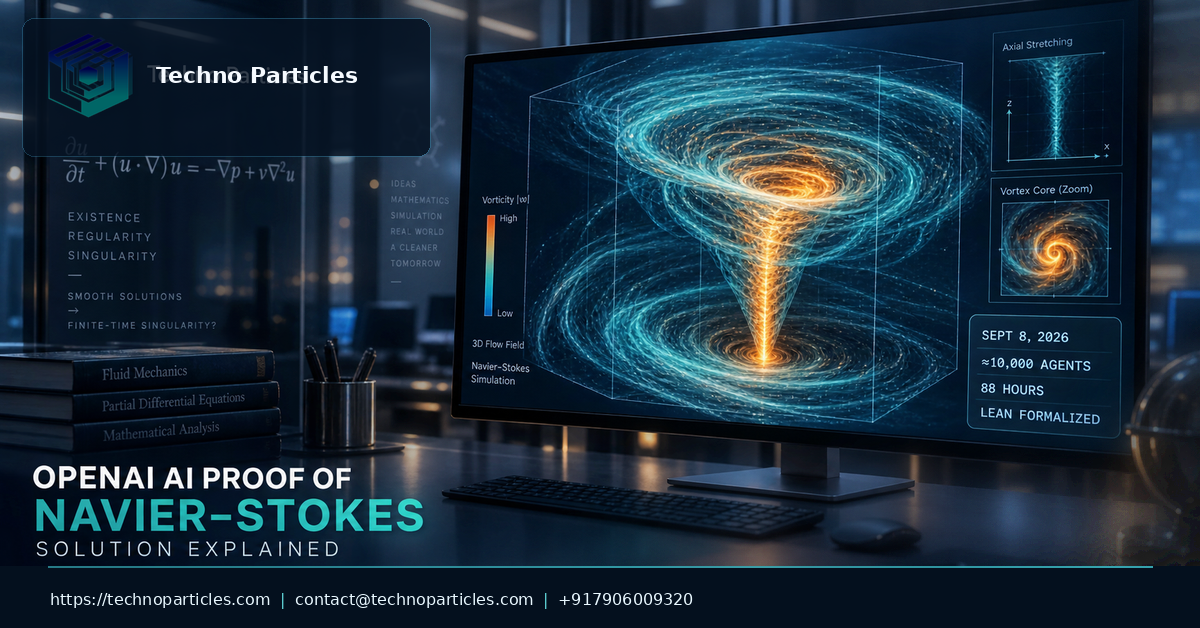
OpenAI has described a large, agent-based research effort rather than a single chatbot producing one answer in isolation. Reports about the project say approximately 10,000 AI agents worked on the problem for about 88 hours, exchanging millions of messages and generating a very large amount of mathematical text. OpenAIâs announcement presents the work as a collaboration between mathematicians, AI researchers, and an internal system substantially more capable at mathematical reasoning than ordinary conversational models.
The exact scale is interesting, but it is not evidence of correctness by itself. More agents can search more ideas, challenge proposed lemmas, rewrite failed approaches, and divide a difficult proof into smaller tasks. Yet a large search process can also generate noise, repeated errors, and arguments that look persuasive until a hidden assumption is exposed. The useful question is not how many tokens were produced, but whether every important step follows from clearly stated definitions and accepted results.
A central part of the reported workflow was formalisation in Lean, a proof assistant that checks mathematical statements through a computer-readable framework. OpenAI says the proof was formalised and verified after the system generated the core argument. Lean verification is valuable because it can catch many gaps in symbolic reasoning, incorrect applications of lemmas, and mismatched assumptions. It provides a much stronger checkpoint than asking a language model whether its own explanation sounds correct.
Why Lean verification is important, but not the whole story
Formal verification does not automatically answer every question surrounding a research claim. A formal proof is only as meaningful as the theorem that was encoded. Researchers must still confirm that the formal statement matches the original Clay problem, that the definitions represent the intended physical and mathematical setting, and that no relevant condition was weakened or changed during translation.
There is also a communication challenge. An AI-generated proof may be formally valid while remaining difficult for human experts to understand. Mathematics is not only about obtaining a yes-or-no certificate. Specialists want to know which ideas are new, why the construction works, how it relates to previous literature, and whether the method can be adapted to other equations. OpenAI has acknowledged that its first proof was difficult to parse and required further work to make the reasoning intelligible.
This is where the application development mindset becomes useful. A research AI tool should preserve versions, assumptions, failed attempts, evidence, and reviewer comments rather than outputting only a polished final answer. Teams can use a content or knowledge-management system to organise technical artefacts, while custom dashboards can show which claims have been formally checked and which still depend on human judgment.
The controversy around timing and attribution
The announcement also triggered debate about priority. Mathematicians Tristan Buckmaster and Levent Alpöge had been working on closely related fluid-dynamics questions and publicly shared results involving finite-time blow-up for nearby equations. OpenAI says it learned that outside researchers were approaching a breakthrough, then accelerated its own project. The company recognised their work while asserting that its internal result was distinct.
That dispute does not, by itself, determine whether OpenAIâs proof is correct. It does highlight a major issue for AI-assisted science: ideas can be rediscovered, transformed, or combined at machine speed, making intellectual provenance harder to trace. Any accepted result will need careful comparison with earlier work and clear credit for the human and computational contributions involved.
What remains to be verified
The most important development after the announcement will be independent scrutiny. Mathematicians need access to the complete proof, its formal Lean code, and enough documentation to reproduce the claimed correspondence between the code and the official NavierâStokes problem. They will examine whether the construction satisfies the exact hypotheses, whether every regularity claim is justified, and whether the conclusion genuinely establishes a finite-time singularity under the permitted conditions.
The Clay Mathematics Instituteâs process also matters. Its Millennium Prize Problems are not settled simply because a company or researcher posts a manuscript. A proposed solution must be published in a qualifying outlet and withstand sustained examination before the institute considers general acceptance. The prize criteria are designed to separate an exciting claim from a result that becomes part of established mathematics.
That caution is especially important because the wording of the NavierâStokes problem allows several formulations. Results involving external forcing may be mathematically valid while answering a different version of the question than the one many readers imagine. Likewise, a proof about the related Euler equations can be highly informative without automatically resolving the viscous NavierâStokes case. The assumptions are not fine print; they are the problem.
What the development means for AI users
For developers and businesses, the lesson is not to ask a general-purpose AI system for an important proof and accept its first response. A dependable workflow should separate discovery from verification. Models can suggest approaches, search literature, write code, generate formal statements, and identify possible counterexamples. Domain experts must define the target precisely, review the assumptions, and decide whether the final result answers the question that was actually asked.
This pattern applies outside mathematics. A company building an AI assistant for legal documents, healthcare operations, finance, or engineering needs audit trails, access controls, source tracking, and human approval. SEO and analytics systems also benefit from this discipline: generated recommendations should be tied to observable data rather than presented as guaranteed outcomes. The same principle is relevant to UI/UX design, where user research and testing remain necessary even when AI proposes an attractive interface.
Indian startups and SMEs can take a measured approach. Begin with bounded research tasks such as document comparison, simulation-code assistance, internal knowledge search, or anomaly detection. Store the evidence behind every output and involve qualified reviewers when errors could affect safety, compliance, or financial decisions. AI can reduce the cost of exploring possibilities, but verification remains the source of trust.
OpenAI AI proof of Navier-Stokes solution explained: the bottom line
The OpenAI AI proof of NavierâStokes solution is best described as a remarkable and consequential claim, not yet an unquestionable victory. OpenAI says its internal system found a finite-time singularity result and that the work was formalised in Lean. If independent mathematicians confirm that the formal proof addresses the official problem under the correct assumptions, the achievement could become one of the most important demonstrations of AI-assisted mathematical research.
For now, the right response is curiosity paired with restraint. The headline shows what advanced AI may be able to discover; the review process will show whether the discovery is correct, original, understandable, and accepted. Businesses planning their own AI initiatives should draw the same conclusion: impressive generation is only the beginning. Reliable systems combine strong models with precise scope, transparent evidence, specialist review, and carefully designed digital platforms that make every important decision traceable.
Why formalisation changes the AI mathematics debate
A formal proof changes the standard for evaluating an AI-generated mathematical claim. In ordinary research, experts inspect definitions, logical transitions, calculations, and references before deciding whether an argument is sound. Formalisation adds another layer: the statement and its proof must be expressed in a language whose rules can be checked mechanically. That does not make the result automatically correct, but it can expose missing cases, ambiguous notation, and steps that appear obvious only in an informal explanation.
What independent reviewers still need to examine
Reviewers would first need to compare the formal theorem with the original NavierâStokes question. The equations, domain, boundary conditions, regularity assumptions, and meaning of a singularity must all match the intended problem.



Leave a comment