

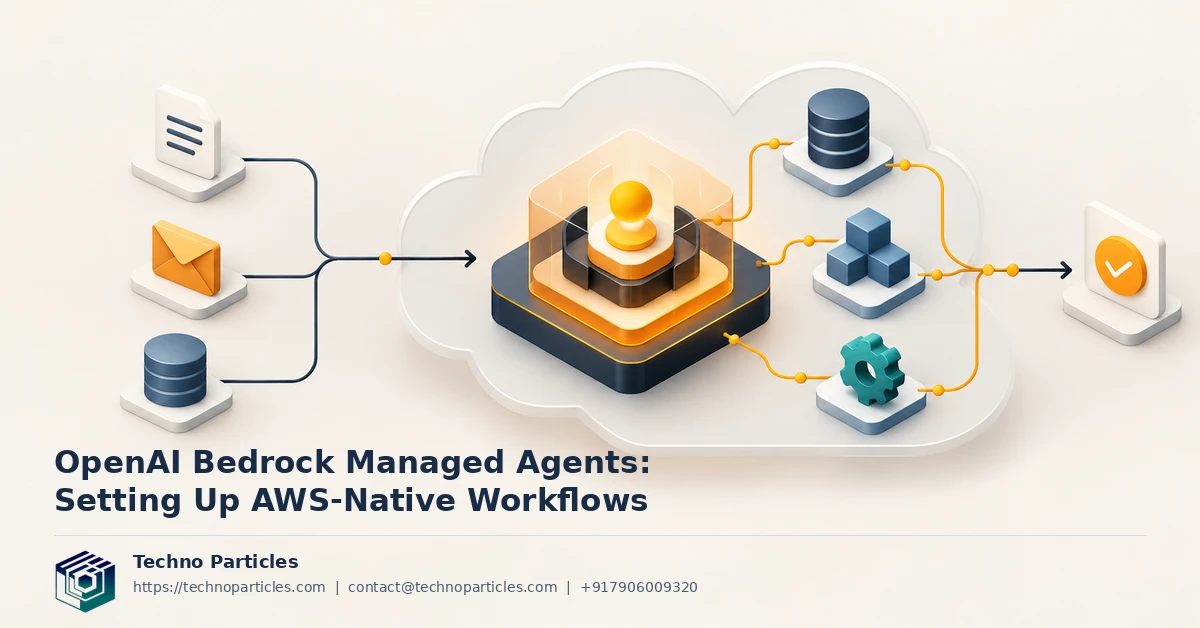
OpenAI Bedrock Managed Agents brings OpenAI-powered, stateful agents into Amazon Web Services environments. AWS currently documents the service as a public-preview offering, while OpenAI described its April 28, 2026 launch as a limited preview. The important change is architectural: the agent loop and model inference run through Amazon Bedrock, while tools and commands can execute in customer-managed compute or Amazon Bedrock AgentCore Runtime.
For businesses, this creates a path to connect natural-language tasks with AWS-native systems without moving every workflow to a separate platform. An agent could process documents, inspect a codebase, update a CRM or ERP record, prepare an approval request, or coordinate internal automation. The practical value depends on carefully scoped tools, permissions, and human reviewânot simply on giving an agent broad access to company systems.
What OpenAI Bedrock Managed Agents changes for AWS teams
The service adapts OpenAIâs Agents API for AWS deployment. Sessions retain conversation context, AWS IAM and Signature Version 4 support authentication, and execution can occur through AgentCore Runtime or self-hosted compute. This makes the service particularly relevant to organizations already operating inside AWS and managing identity, networking, logging, and deployment there.
It is also important to distinguish this preview from Amazon Bedrock Agents Classic. AWS says the classic service is no longer open to new customers, so teams evaluating an agent architecture should review the newer Managed Agents documentation and its current feature boundaries before committing to an implementation.
Requirements before starting the setup
A basic setup requires an AWS account, access to a supported Region and model, IAM roles, Node.js 20 or newer, AWS CLI v2, Bash, cURL, jq, and Codex CLI 0.154.0 or later. AgentCore deployment adds Python 3.12 or newer, Docker with Linux ARM64 build support, and AWS CodeBuild-based image deployment. AWS lists preview endpoints in us-east-1, us-west-2, and us-east-2, although account and model availability can vary.
Teams planning the application layer can also review application development services for guidance on integrating agent workflows with business software.
OpenAI Bedrock Managed Agents setup for AWS-native business workflows
Once the prerequisites are available, begin with a small workflow and verify access before connecting production systems. Confirm the selected AWS Region, request access to the required Bedrock model, and configure the documented IAM roles. The setup also uses AWS Signature Version 4, so credentials, permissions, and region settings must be tested from the same environment that will run the agent.
Choose the execution model according to the workflowâs operational needs. Self-hosted compute can suit teams that already manage their own application environment, while Amazon Bedrock AgentCore Runtime provides a managed path for deploying agent tools and commands. AgentCore deployment requires additional packaging and infrastructure work, including Python 3.12 or newer, Docker with Linux ARM64 build support, and AWS CodeBuild-based image deployment.
Design tools around controlled business actions
The most important implementation decision is the tool boundary. Instead of exposing an entire database or cloud account, create narrowly defined actions such as âretrieve an approved customer record,â âdraft an invoice,â or âsubmit a purchase request for review.â Each action should validate inputs, record the requesting session, and return only the data needed for the next step.
AWS documents separate caller, session, and execution identities for Managed Agents. Keep these identities distinct and apply least-privilege permissions. Review every use of iam:PassRole, because an overly broad role-passing permission can expand what an agent or deployment process is able to run. Approval gates are especially useful for CRM updates, financial operations, employee records, and production code changes.
For an implementation that connects the agent to a website, CRM, ERP, or internal dashboard, teams can explore project consultation for workflow planning. The preview status also warrants operational safeguards: log tool calls, monitor failed actions, test regional failover assumptions, and keep a fallback process available while APIs and supported models continue to evolve.
OpenAI Bedrock Managed Agents: Setting Up AWS-Native Workflows - Techno Particles
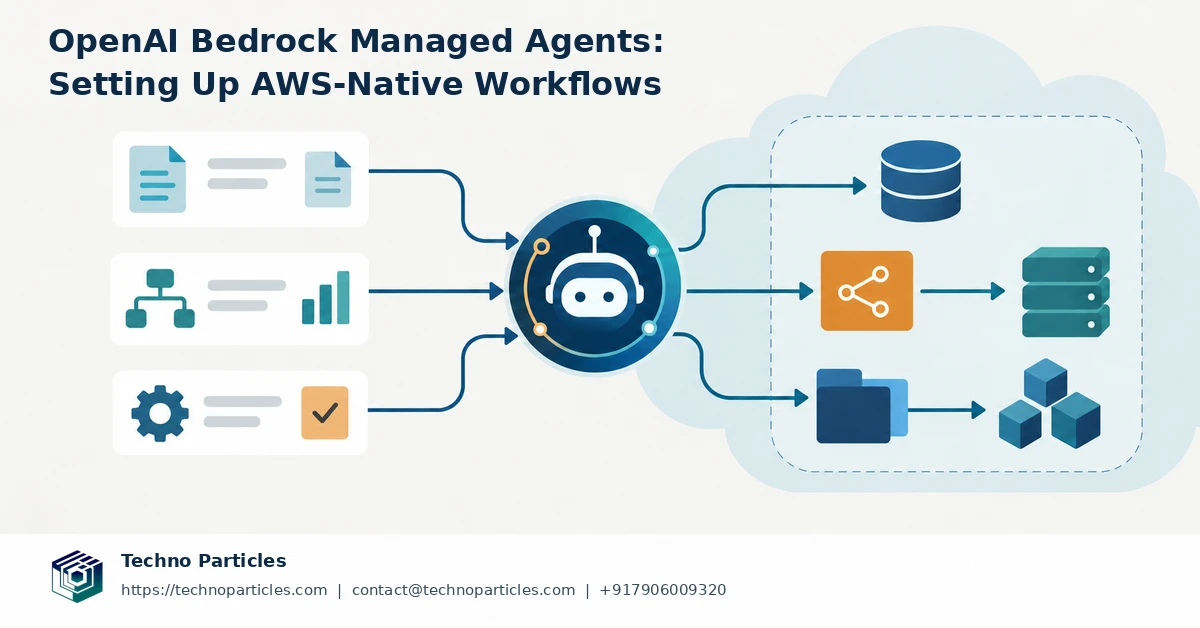
OpenAI Bedrock Managed Agents setup for AWS-native business workflows
Start with a small, low-risk workflow and verify access before connecting production systems. Confirm the selected AWS Region, request access to the required Bedrock model, and configure the documented IAM roles. Because authentication uses AWS Signature Version 4, test credentials, permissions, and Region settings from the same environment that will run the agent.
Choose the execution model according to the workflowâs operational needs. Self-hosted compute may suit teams that already manage their own application environment, while Amazon Bedrock AgentCore Runtime offers a managed path for deploying agent tools and commands. AgentCore deployment adds packaging and infrastructure requirements, including Python 3.12 or newer, Docker with Linux ARM64 build support, and AWS CodeBuild-based image deployment.
Design tools around controlled business actions
The most important implementation decision is the tool boundary. Rather than exposing an entire database or cloud account, create narrowly defined actions such as retrieving an approved customer record, drafting an invoice, or submitting a purchase request for review. Each action should validate inputs, identify the requesting session, and return only the information needed for the next step.
AWS documents separate caller, session, and execution identities for Managed Agents. Keep these identities distinct and apply least-privilege permissions. Review every use of iam:PassRole, because an overly broad role-passing permission can expand what an agent or deployment process may run. Approval gates are particularly important for CRM updates, financial operations, employee records, and production code changes.
For an implementation connecting the agent to a website, CRM, ERP, or internal dashboard, teams can explore project consultation for workflow planning. During the preview, log tool calls, monitor failed actions, test regional assumptions, and maintain a fallback process while APIs and supported models evolve.
Where OpenAI Bedrock Managed Agents fitsâand where it does not
The strongest early use cases are workflows that need persistent context, controlled tool calls, and access to AWS-hosted business data. A document-processing agent could classify an uploaded file, extract requested fields, check them against approved records, and route exceptions to a human. In a CRM or ERP, an agent could gather information, prepare a proposed update, and wait for approval before changing the system of record. Internal codebase work, operations checks, and employee-service requests can follow the same pattern when each action has a narrow permission boundary.
That design is different from giving a general-purpose chatbot unrestricted access. Managed Agents can preserve session context, but the surrounding application still needs input validation, audit logging, timeout handling, and clear recovery behavior when a tool fails. Treat the modelâs output as a proposed action until the application has checked authorization and business rules.
Preview status, costs, and compatibility need attention
OpenAI Bedrock Managed Agents remains a limited public preview, so APIs, supported models, and regional access may change. AWS lists preview endpoints in selected Regions, but an endpointâs existence does not guarantee that every account or model is enabled there. Teams should confirm current access in their own AWS environment and avoid designing a rollout around one unverified model or Region.
Budget for more than model inference. AgentCore deployments may create charges for storage, networking, build services, and NAT Gateway usage, while self-hosted execution shifts more responsibility to the customerâs infrastructure team. Estimate costs with a small test workflow, measure tool-call frequency, and set appropriate AWS budgets before expanding usage.
Also distinguish this service from Amazon Bedrock Agents Classic, which AWS says is no longer open to new customers. For organizations evaluating a production workflow, an application development team experienced in system integration can help compare the previewâs Bedrock-native approach with existing APIs, queues, approval services, and human-operated fallback processes.

Plan a measured rollout
A practical rollout should begin with a non-destructive task, such as classifying documents, checking internal records, or preparing a draft response. Keep the first tool set small and require human approval before any action changes a CRM, ERP, financial record, employee record, or production environment. This makes it easier to inspect the agentâs reasoning path, tool inputs, returned data, and failure behavior.
Define session boundaries before deployment. Since Managed Agents can retain conversation context, the application should decide how long a session remains active, which users may resume it, and what information must be excluded from future turns. Sensitive records should be filtered at the tool layer, not merely hidden in the interface. Logs should capture identity, timestamp, requested action, authorization result, tool response status, and whether a person approved the operation.
Teams should also test ordinary failure scenarios: expired credentials, unavailable models, malformed tool arguments, throttling, network interruptions, and incomplete business data. A useful fallback might route the request to an employee, place it in a review queue, or preserve a draft for later completion. These controls matter more than making the agent appear fully autonomous.
What businesses should verify before adoption
- Access: Confirm the AWS account, Region, model permissions, preview endpoint, and required IAM roles.
- Execution: Choose self-hosted compute or AgentCore Runtime after comparing infrastructure ownership, deployment effort, and expected costs.
- Security: Separate caller, session, and execution identities, then review least-privilege policies and
iam:PassRoleusage. - Operations: Establish logging, approval rules, monitoring, budgets, rollback procedures, and a human fallback.
For Indian SMEs and larger teams connecting AWS automation with existing business software, an SEO-aware website development partner can help expose approved workflow actions through a secure internal interface. The key is to treat OpenAI Bedrock Managed Agents as an orchestration layer inside a governed application, not as a replacement for access control, testing, or accountable business processes.
What businesses should verify before adoption
OpenAI Bedrock Managed Agents is most useful when an AWS-native workflow needs persistent context, controlled tool calls, and access to business systems. Begin with a non-destructive task such as classifying documents, checking internal records, or preparing a draft response. Require human approval before an agent changes a CRM, ERP, financial record, employee record, or production environment.
Before deployment, confirm that the AWS account, selected Region, model permissions, preview endpoint, and IAM roles are available. Choose between self-hosted compute and Amazon Bedrock AgentCore Runtime after comparing infrastructure ownership, deployment effort, security responsibilities, and expected costs. AgentCore deployments may also introduce storage, networking, build-service, and NAT Gateway charges beyond model inference.
Security needs separate caller, session, and execution identities, along with least-privilege policies and careful review of iam:PassRole. Since sessions can retain conversation context, define session duration, resumption rights, and rules for sensitive data. Logs should record the identity, requested action, authorization result, tool status, and human approval where applicable.
Test predictable failure cases, including expired credentials, unavailable models, malformed tool arguments, throttling, network interruptions, and incomplete records. A reliable fallback may send the request to an employee, place it in a review queue, or preserve a draft for later completion. These controls are especially important because the service remains in preview and its APIs, supported models, and regional availability may change.
The practical takeaway
Do not treat OpenAI Bedrock Managed Agents as an unrestricted autonomous replacement for business software.


Leave a comment