
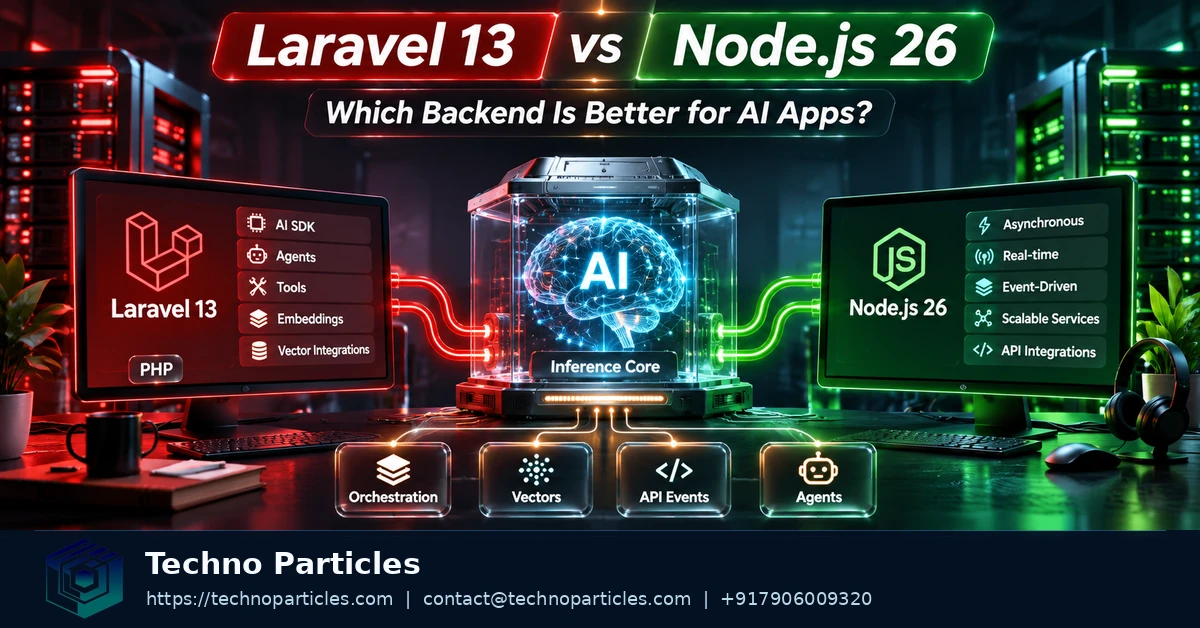
Laravel 13 and Node.js 26 represent two different ways to build AI applications. Laravel 13, released on March 17, 2026, adds first-party AI tooling inside a structured PHP framework. Node.js 26, first released on May 5, 2026, provides a JavaScript runtime built around asynchronous, non-blocking I/O. The better backend depends on whether the project values framework-native AI features or JavaScript ecosystem alignment.
| Factor | Laravel 13 | Node.js 26 |
|---|---|---|
| Foundation | PHP framework requiring PHP 8.3 or newer | Asynchronous JavaScript runtime with an event-loop model |
| AI direction | First-party SDK for text, agents, embeddings, audio, images and vector stores | Runtime and HTTP foundation; AI capabilities depend on selected libraries and provider SDKs |
| Support signal | Bug fixes for 18 months and security fixes for two years | Published release-line lifecycle through April 2029 |
| Cost signal | No framework AI quota or subscription price established | No runtime-level AI quota or provider price established |
Which backend is better for AI apps: Laravel 13 or Node.js 26?
Laravel’s official Laravel 13 release notes identify the March 17 release and describe its AI SDK, JSON:API resources, semantic search support and other framework additions. Laravel’s April 1, 2026 product update further presents the release as a significant expansion of its application and AI-building tools.
Node.js follows a runtime-first model. The official release page records Node.js 26’s first release on May 5, 2026, while the published schedule places its LTS transition in October 2026, maintenance in October 2027 and end of life in April 2029. The October 14, 2026 Node.js 26.12.0 release is labelled “Current,” so the release label and schedule should be read together.
That difference affects application planning. Laravel supplies more AI-specific conventions at framework level, while Node.js leaves more architectural choices to the team and its JavaScript or TypeScript dependencies. For a business product, this also shapes application development planning, especially when authentication, queues, retrieval and deployment must fit one delivery process.
How Laravel 13 and Node.js 26 approach AI development
Laravel 13 treats AI as a framework capability. Its official release notes describe a first-party AI SDK for text generation, tool-calling agents, embeddings, audio, images and vector-store integrations. The same release adds semantic and vector-search APIs, giving PHP teams a more defined path from application request to retrieval workflow. These features do not host models or remove provider choices, but they can reduce integration work for teams already building in Laravel. See the AI development services page for the broader delivery context.
$response = SalesCoach::make()->prompt('Analyze this sales transcript...');This framework-native approach is useful when an AI product also needs business rules, authentication, queues, structured data and administrative workflows. The application can keep those concerns within one PHP ecosystem while connecting the AI layer to an external model or vector service.
Node.js 26 starts from a different premise. The official Node.js documentation describes an asynchronous, non-blocking runtime with a single-process event loop and a standard HTTP library. It supplies the server foundation, while the team selects JavaScript or TypeScript libraries for model access, agent orchestration, embeddings, retrieval and observability. That composition can fit products that already share types, packages and tooling across the browser and server.
The practical divide is simple: Laravel offers more AI-specific structure at framework level; Node.js offers runtime flexibility and direct access to its ecosystem. Neither choice determines model quality, inference cost or retrieval accuracy. Those depend on the selected provider, prompts, corpus, vector system and application design.

Where the AI integration boundary sits
The main architectural difference appears at the boundary between application code and AI services. Laravel 13 gives PHP developers framework-level patterns for prompting, tool-calling agents, embeddings, media generation and vector-store connections. That can make an AI feature feel like another application service: controllers receive requests, domain logic applies permissions, queues handle longer work, and the AI layer is called from established Laravel code.
Node.js 26 provides fewer framework opinions about those upper layers. Its official runtime model centres on asynchronous, non-blocking operations, while its HTTP API documentation exposes lower-level server and streaming primitives. The team can then assemble provider SDKs, retrieval libraries, validation, authentication and job processing according to the application’s needs. This is valuable when the same JavaScript or TypeScript types and packages are shared across browser, server and worker code.
That flexibility also moves more decisions into the project. The team must select how prompts are represented, how tool calls are validated, where embeddings are stored, how retries are handled and which observability signals matter. Laravel’s conventions may shorten those decisions for a PHP business application, while Node.js may reduce friction for an existing JavaScript platform.
For teams planning technical project consultation, the useful question is not which backend has the more impressive AI vocabulary. It is where the project wants its integration boundary: inside a framework with established application conventions, or across a composable runtime and library stack. The answer should follow the existing codebase and delivery skills before any benchmark is designed.
Which backend matches the integration workload?
Laravel 13 fits teams that want AI features to follow familiar application patterns. Its release notes place prompting, tool-calling agents, embeddings, audio, image generation and vector-store connections near the framework’s existing services. That matters when the product also needs user roles, admin screens, database workflows and queued business tasks. A PHP team can keep those concerns within one application structure while adding AI capabilities incrementally.
Node.js 26 fits teams that treat the backend as a composable JavaScript or TypeScript platform. Node’s asynchronous, non-blocking model supports concurrent network activity, while its standard HTTP APIs expose server and streaming primitives. The runtime therefore works well when browser and server code share types, validation rules or packages. The AI layer can then be assembled around the provider SDKs, retrieval tools and worker system selected by the project.
This distinction does not make one backend faster by default. Laravel’s framework conventions may reduce delivery effort for a PHP business application. Node.js may reduce coordination effort for an established JavaScript platform. Neither official source supplies a benchmark proving lower latency, lower inference cost or better retrieval quality. Those outcomes depend on provider selection, prompt design, database choice, network paths and background-job configuration.
For a new custom application development project, identify the dominant integration constraint first. Choose Laravel when the team benefits most from framework-level AI structure and PHP continuity. Choose Node.js when shared JavaScript or TypeScript tooling, event-driven I/O and ecosystem flexibility carry more weight. This choice defines how much architecture the framework supplies and how much the team must assemble.
How to Compare the Two Backends in One AI Prototype
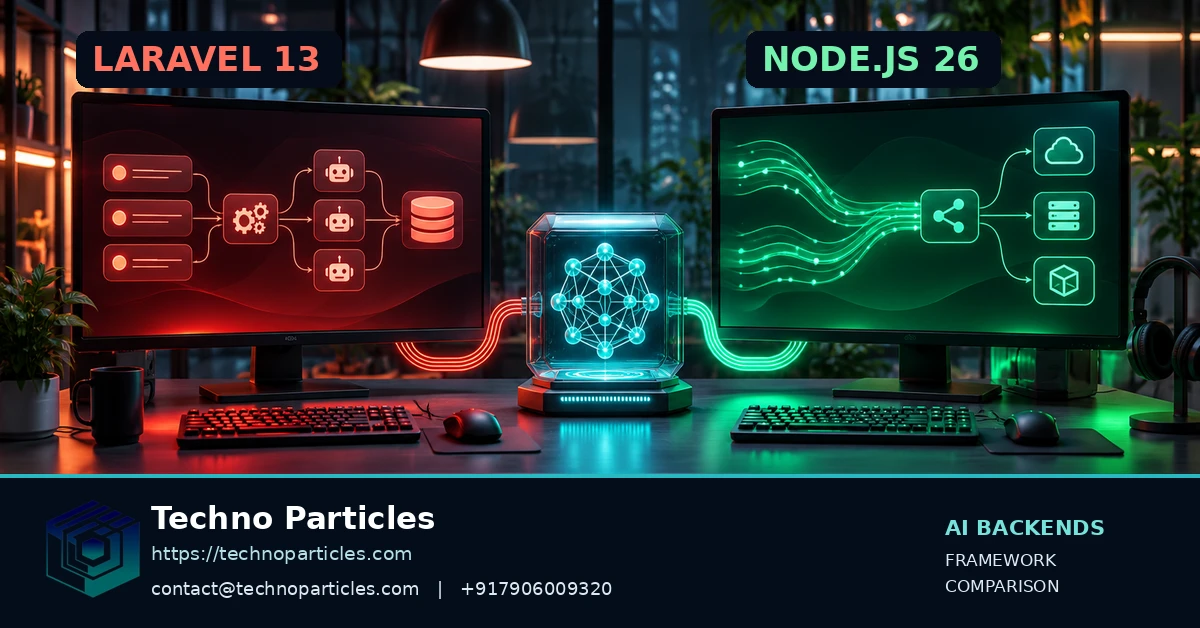
A fair comparison should use one narrow vertical slice, not two unrelated demos. Build the same authenticated endpoint in Laravel 13 and Node.js 26. Send identical prompts, retrieval documents and model requests. Keep database, vector store, deployment region, queue policy and observability tools consistent. This isolates backend workflow from provider and infrastructure differences.
Laravel’s implementation can place the AI request inside its application structure, using the framework’s documented AI SDK patterns for prompting and related services. The Laravel 13 release notes describe support for text generation, tool-calling agents, embeddings, media generation and vector-store integrations. The prototype should measure how much configuration the team needs around authentication, validation, retries and background work.
Node.js exposes a lower-level HTTP foundation. Its v26 documentation shows server creation through createServer():
import { createServer } from 'node:http';

const server = createServer((req, res) => {
  res.writeHead(200, { 'Content-Type': 'text/plain' });
  res.end('okay');
});
This endpoint proves little about AI performance. It only shows where the application receives requests and returns responses. The remaining Node.js design must add provider access, retrieval, validation, job execution and tracing through selected libraries or project code. The Node.js v26 HTTP documentation also covers streaming and request handling, which can matter for token-by-token interfaces.
What the proof of concept should measure
Record delivery effort, completed feature scope, error handling, median and tail response time, token-stream behaviour, queue reliability and retrieval quality. Use the same test prompts and corpus. Separate model wait time from application overhead. Then review code complexity and operational work with the team. A custom application development review can help turn those observations into a deployment decision, but it cannot replace measurements from the target workload.
The Decision Rule for Laravel 13 vs Node.js 26: Which Backend Is Better for AI Apps?
For Laravel 13 vs Node.js 26: which backend is better for AI apps? the decision rule is straightforward: choose Laravel 13 when reducing delivery risk inside a PHP business application matters most; choose Node.js 26 when JavaScript or TypeScript alignment, event-driven I/O, or an established Node ecosystem is the stronger constraint.
Laravel 13 is the better default when the application combines AI with structured business workflows, authentication, permissions, administration, database operations and background jobs. Its first-party AI SDK can reduce the amount of framework integration the team must design around text generation, agents, embeddings, media and vector-store features. That advantage is about application structure and delivery consistency, not proof of superior model results.
Node.js 26 is the better default when the team already operates a JavaScript platform or needs a runtime that fits highly asynchronous network workloads. It provides the server foundation, while the project selects its own provider SDKs, retrieval components, validation approach, worker system and observability stack. That flexibility can be valuable, but it also places more architectural choices on the team.
Neither choice should be justified by assumed latency, price or model quality. Those outcomes depend on the same external factors in both architectures: provider, prompts, retrieval corpus, database, deployment region, network path and queue design.
The next step is to build one small vertical slice in both backends using the same model provider, prompt, documents, database, authentication rules and deployment conditions. Measure delivery effort, application overhead, streaming behaviour, queue reliability, retrieval quality and operational complexity. Select the backend that performs best against the project’s actual constraint, not the one with the more attractive feature list.


Leave a comment
Your email stays private. You can see your comment immediately on this browser. Others see it after approval.