
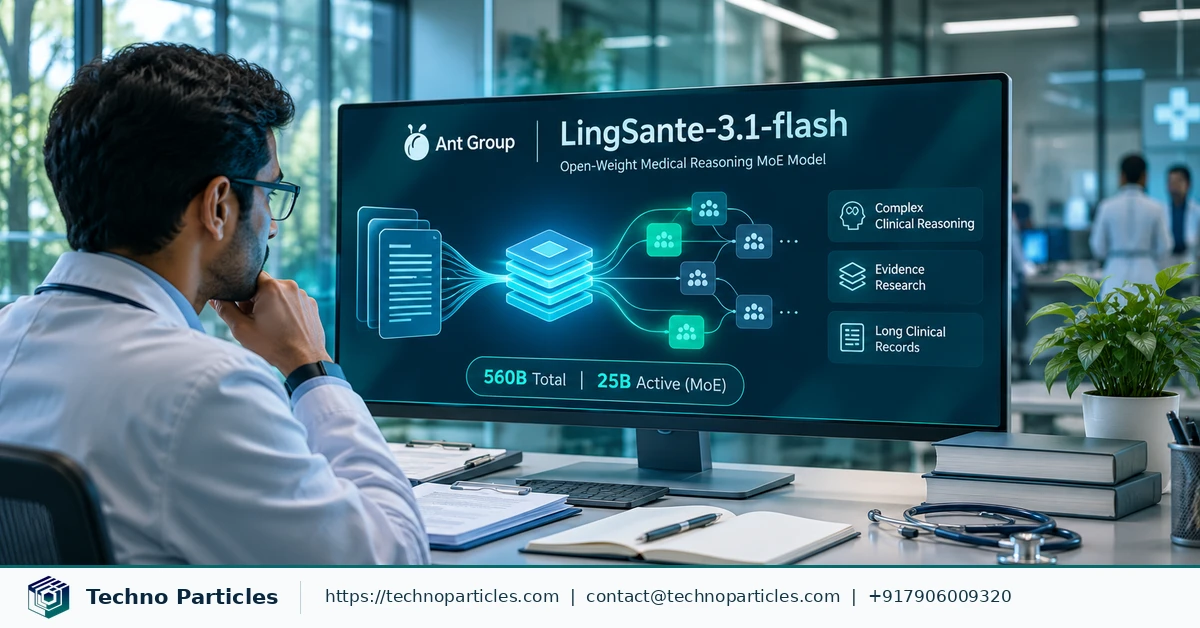
Ant Group’s LingSante release brings an open-weight medical AI model into view for teams exploring research and healthcare workflows. The Ant Group LingSante-3.1-flash open-source medical AI model explained here is designed for medical reasoning and related tasks, with downloadable weights that researchers can examine and deploy. Ant Group announced the model family on November 23, 2026, following an Ant Ling technical post on November 22. Ant Group announcement; Ant Ling technical post.
| Release detail | What the official materials say |
|---|---|
| Model design | Hybrid-linear mixture of experts, with 560 billion total parameters and about 25 billion active per token. |
| Weights and license | Downloadable model weights; the model card lists an MIT license. |
| Intended use | Research and evaluation involving medical reasoning and workflows. |
| Deployment | The model card provides SGLang and vLLM examples and recommends an eight-H200 SGLang configuration. |
These details come from the inclusionAI model card. They offer a starting point for assessing both the model’s intended role and the infrastructure involved in running it.
What Changed With the LingSante Release?
Ant Group’s November 23 announcement introduced LingSante as a medical and health AI model family. LingSante-3.1-flash is the open-weight model in that release, positioned for tasks such as medical reasoning, evidence-based research and professional healthcare communication. Ant Ling’s November 22 technical post describes the model’s design and its role in longer workflows.
Here, open-weight means the model weights are available to download; the MIT listing on the model card describes the stated license. It does not establish that all training data and complete training code have also been released. Teams considering how such a model fits an application can use project consultation to frame requirements before choosing a deployment approach.
How Is LingSante-3.1-flash Built?
LingSante-3.1-flash uses a hybrid-linear mixture-of-experts design. Its 560 billion total parameters represent the model’s full set of learned weights, while approximately 25 billion are active for each token processed. The distinction matters: the full model must be available to the serving system, but each token does not use every parameter. These figures are published in the Ant Ling technical description.
In a mixture-of-experts model, specialized components called experts contribute to processing. The design combines routed experts, selected for particular inputs, with shared experts. This arrangement lets the model draw on different parts of its capacity as it handles a sequence. The term hybrid-linear describes the broader architecture; it should not be read as a guarantee about how quickly a particular deployment will run.
Training for Medical and General Tasks
The inclusionAI model card describes training that combines medical and general material. That combination is relevant to workflows where medical information appears alongside ordinary language, such as a question that mixes a patient’s description with research terminology. The model card also describes reinforcement learning and multi-teacher distillation as parts of the training approach.
Reinforcement learning adjusts model behavior using feedback, while distillation trains a model using outputs or guidance from other models. In a multi-teacher setup, that guidance comes from more than one teacher. These techniques describe how the model was developed; the published architecture and training methods alone do not establish clinical reliability.
For teams designing an application around the model, those distinctions affect the surrounding workflow. An generative AI service can help frame how a model component fits into a larger application, including where information enters and how its output is used. The architecture itself describes the model, not the complete application that would surround it.

What Can LingSante-3.1-flash Do in Medical Workflows?
LingSante-3.1-flash is intended to support work that spans more than a single question and answer. Ant Group describes uses including medical reasoning, evidence-based research and healthcare communication in its November 23 announcement. These tasks can involve interpreting a question, comparing information and presenting an explanation to a particular audience.
For evidence comparison, a researcher might use the model to organize findings from several documents and identify points that need closer examination. Multi-document analysis is useful when relevant details are spread across papers or other materials, but the resulting synthesis still needs to be checked against the underlying sources. A workflow can also involve search and verification tools, allowing the model to gather information during a longer sequence of steps.
Examples and Evaluation Claims
Ant Ling describes a sleep-analysis example and medical simulations as demonstrations of how the model could participate in longer workflows. The model’s professional-behavior evaluation considers another aspect of use: how it communicates and acts in healthcare-related scenarios, alongside its ability to reason about information.
The model card reports an InclusionMed overall score of 45.064 and fifth place among 23 evaluated model configurations. It also reports second place on a medical professional-behavior benchmark. These are company-published evaluation claims; demonstrations and benchmark results do not establish clinical effectiveness or independently validate the model for patient care.
For an application team, the practical question is how to connect a model’s output to the people and information involved in the task. For example, an interface could present a document synthesis alongside the materials a reviewer needs to inspect. The surrounding application development work determines how that information is presented and how a reviewer moves through it.
Availability, Deployment, and Context Limits
LingSante-3.1-flash weights are available through Hugging Face and ModelScope in FP8 and MXFP4 formats. Ant Ling also links to an online model service and an API access route in its technical post. Teams can therefore assess self-hosting alongside the hosted route, with infrastructure ownership as a key difference.
The model card provides SGLang and vLLM deployment examples. Its recommended SGLang configuration uses eight H200 GPUs; it also describes an alternative using four GB300 GPUs. Those recipes make self-hosting a substantial infrastructure decision, rather than a lightweight application dependency. Capacity planning should account for the full checkpoint and the serving environment, not only the parameters active for each token.
Pricing and the Context-Window Discrepancy
Ant Ling’s pricing page, updated November 24, 2026, lists prices for Ling-3.1-flash. It does not establish a LingSante-3.1-flash-specific price or quota. Teams considering hosted access should check the model service for terms applicable to the medical model, rather than applying the separate Ling pricing to it.
Ant Group claims a context window of up to one million tokens, while the published model configuration sets max_position_embeddings to 262144. These figures do not establish the same runtime limit. Verify the effective context supported by the selected serving stack before sizing a document workflow.
For a self-hosted application, the model server is one part of the delivery work. The application development service covers the surrounding application, where teams can define how users submit documents and receive model output. That integration should be scoped against the selected deployment route and its resource requirements.

Safety Boundaries for Medical AI Use
LingSante-3.1-flash is intended for research and evaluation, according to its official model card. The card states that it is not a medical device and must not independently diagnose a patient, prescribe medication, determine treatment or make clinical triage decisions. Those boundaries matter even when an application presents its output in a confident or professionally formatted response.
A team evaluating a document assistant should assign qualified people responsibility for reviewing its output and deciding whether it can be used. The application should make that responsibility clear: a model-generated draft can support a reviewer’s work, but it should not become an automatic instruction to a patient or a clinician. A human approval point is especially relevant before information leaves an internal workflow or triggers an action in another system.
Control Data and Tool Access
Medical documents can contain sensitive personal information, so an evaluation needs a defined approach to data handling. Teams should establish who can submit and view material, what information the model service receives, and how outputs and records are retained. The design also needs to account for applicable healthcare and privacy requirements in the places where the application will operate.
When the model can call search or other tools, permissions should be limited to what the task requires. For example, a document-analysis workflow may need access to a defined collection of reference material without permission to change patient records. Audit logs can help an authorized reviewer understand which tools were used and where an output came from.
These decisions belong in the workflow design as well as the model evaluation. A project consultation service can support requirements discovery and scope definition, including the review roles and access boundaries an application needs before implementation.
When Should Teams Evaluate LingSante-3.1-flash?
Teams considering Ant Group LingSante-3.1-flash open-source medical AI model explained in this article should evaluate it only if they can provide qualified human review, controlled data handling and a verified serving setup. The next step is to run a narrow pilot using de-identified documents and a predefined review set.

Leave a comment
Your email stays private. You can see your comment immediately on this browser. Others see it after approval.